BESE TESTIMONY OF DR. SHERLEY BRETOUS, EXECUTIVE DIRECTOR BENJAMIN BANNEKER CHARTER PUBLIC SCHOOL ON 2026 MCAS SUCCESS AND STRATEGIES
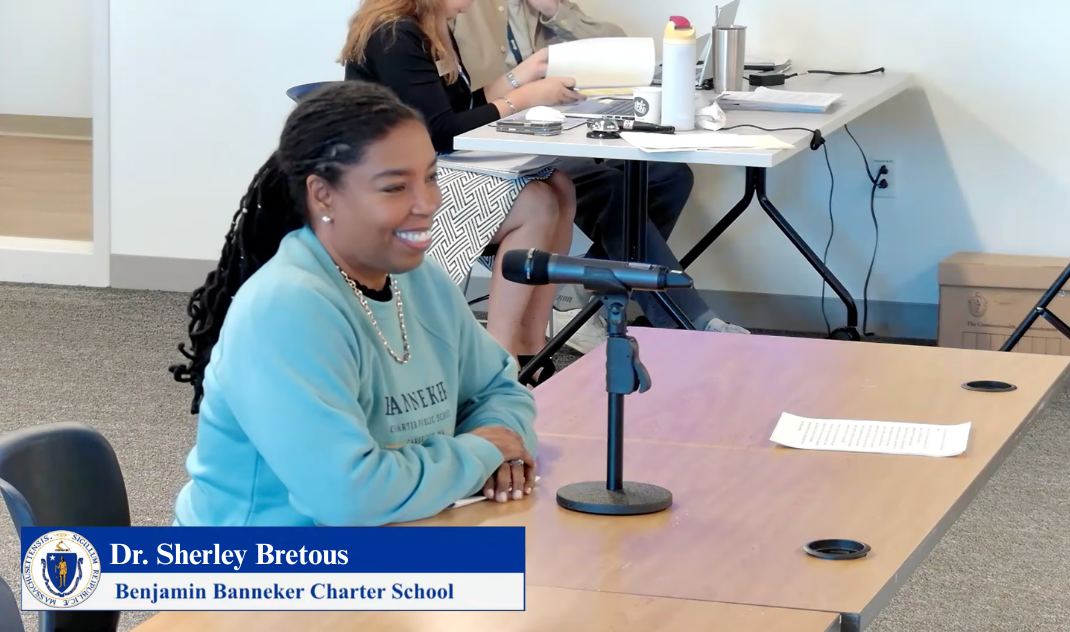
September 22, 2026 | Dr. Sherley Bretous, Executive Director of Benjamin Banneker Charter Public School
On September 22, 2026, Dr. Sherley Bretous, Executive Director of Benjamin Banneker Charter Public School in Cambridge, testified before the Massachusetts Board of Elementary and Secondary Education (BESE) on her school’s 2026 MCAS results and the instructional practices behind them. Banneker is one of only 14 districts statewide to have achieved 2019 pre-pandemic performance levels in both reading and math for grades 3–8. Banneker students scored 81% meeting or exceeding expectations in ELA, 87% in Mathematics, and 80% in Science — with no students scoring in the “Not Meeting Expectations” category in Mathematics. Read her full testimony below.
Good morning. I’m Dr. Sherley Bretous, Executive Director of the Benjamin Banneker Charter Public School in Cambridge. Thank you for the opportunity to celebrate our students’ 2026 MCAS success and share the practices that support it. These results reflect the hard work of our students, the dedication of our staff, and the partnership of our families.
The Banneker enrolls students in Pre-K through grade six. 99% of our students identify as children of color. Nearly two-thirds are classified as high needs. Over our 30 years of operation, we have consistently demonstrated that all students — including Black and brown students, students from low-income homes, students with special needs, and multilingual learners — all students can achieve at the highest levels.
Our 2026 MCAS results continue to demonstrate that truth:
- In ELA: 81% of our students met or exceeded expectations.
- In Mathematics: 87% met or exceeded expectations.
- In Science, 80% met or exceeded expectations.
At the Banneker, we are focused on helping our students achieve excellence and that bears out in our data. This year, we were able to meaningfully increase the percentage of students exceeding expectations in both ELA and mathematics.
- In ELA: 32% of Banneker students exceeded expectations, an increase of 5 percentage points from 2025.
- In Mathematics: 35% of our students exceeded expectations, an increase of 6 percentage points. And notably, on the other end of the spectrum, no students scored in the Not Meeting Expectations category.
We are proud of our children and the work behind these results, which place Banneker students amongst the very top-performing students in the state.
What is it, you might be wondering, that helps us achieve these strong outcomes?
For us, this begins with what we believe about children. We expect our students to achieve at high levels. Every adult in our building believes deeply in the potential of every child, and we message that belief to our students every single day.
It is our responsibility to give our students what they need to get there.
That requires several elements. It’s important to first name what is not part of our success. We do not drill students. Instead, our focus is on creating a joyful learning environment that helps students become skilled readers, writers, scientists, thinkers, artists, problem-solvers, and mathematicians. If we do that well, strong outcomes on the MCAS will naturally follow.
So, what is our approach?
First, we have a rigorous curriculum rooted in an equity lens. Our internally designed curriculum is grounded in Massachusetts standards, research-based practices, and the identities and needs of our students. Our curriculum is vertically aligned and interdisciplinary. Teachers work together across classrooms and grade levels so that learning builds from one year to the next.
Secondly, we use regular data to drive timely, individualized interventions that provide students the extra support or extra challenge they need, when they need it. Through regular assessments, we constantly monitor every student’s progress, and we adjust instruction accordingly. Importantly, the expectation stays high for every child. It’s the supports that vary to meet each child’s unique needs.
Thirdly, we also know that teachers need support. Job-embedded professional development, coaching, and teacher associates help our teachers respond to the children in front of them. Staff share strategies, work through challenges, and take responsibility for student success together.
Finally, at the heart of all of this are relationships — relationships amongst staff, between staff and students, and between staff and families. At the Banneker, our commitment to diversity, inclusion, and our mission helps create a community where staff feel supported, children feel that they belong, and families are our partners.
We are proud of these results, but we are not finished. We will continue to strengthen the practices that are working: unfailingly high expectations, rigorous instruction, thoughtful use of data, support for teachers, and deep relationship-building.
Our success belongs to our students, our staff, and our families. I am proud to share on behalf of our Banneker community.
Thank you.