How Massachusetts Charter Public Schools Are Reducing Chronic Absenteeism
November 16, 2026 | Massachusetts Charter Public School Association
What is chronic absenteeism, and why does it matter?
Students can’t learn when they aren’t in the room, and the days add up fast. A student is chronically absent if they miss 10% or more school days in a year. In Massachusetts, that is about 18 days in a standard 180-day year, excused and unexcused absences alike.
Chronic absenteeism rose sharply after the pandemic in all schools. It has since fallen to 17.1% statewide in 2025-26, but missed days are still up nearly a third and nearly a third of districts remain above 20%.
While every student population has seen a rise in chronic absenteeism since before the pandemic, the burden is not shared equally. Statewide, Hispanic or Latino, American Indian or Alaska Native, English learner, high-needs, low-income students, and students with disabilities continue to be the most affected. The Globe reports that nearly a third of low-income students have been chronically absent since the pandemic, and that each missed day costs these students more. For immigrant families, fear is part of the picture too: the Globe found that immigration raids fueled a surge in absences in communities like Hudson and Martha’s Vineyard. The U.S. Department of Education points to student disengagement, limited access to student and family supports, and health challenges as significant drivers.
Closing this gap is where the work matters most, and charter public schools across the state are showing what progress can look like.
The schools below have each made substantial progress, at least a 15-point drop, in reducing chronic absenteeism below the statewide average since 2021-22:
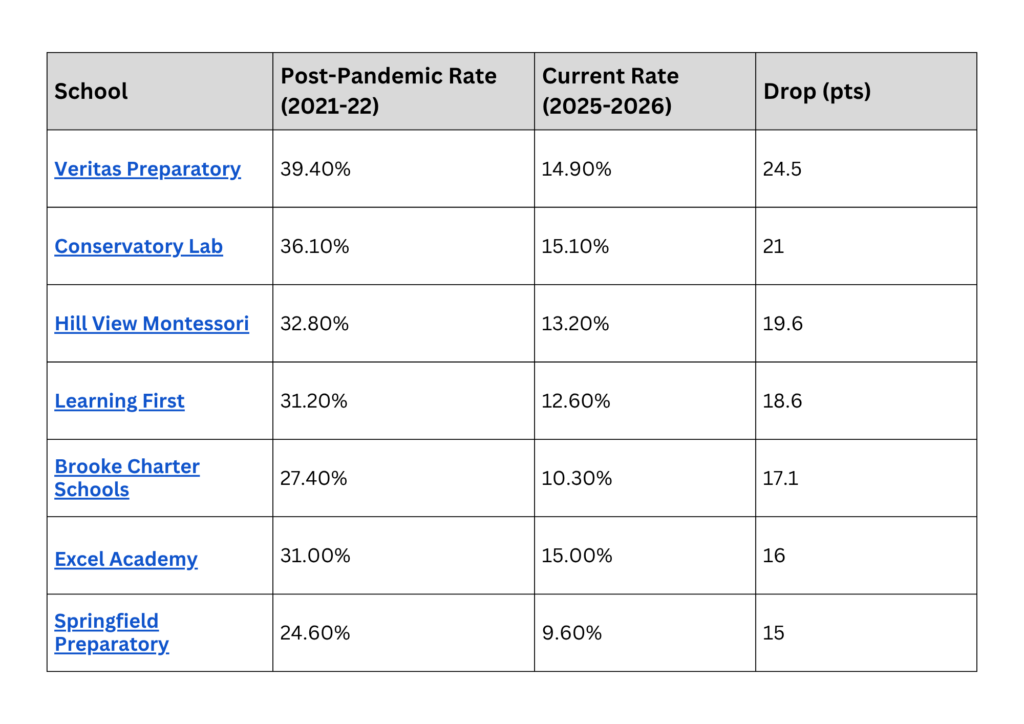
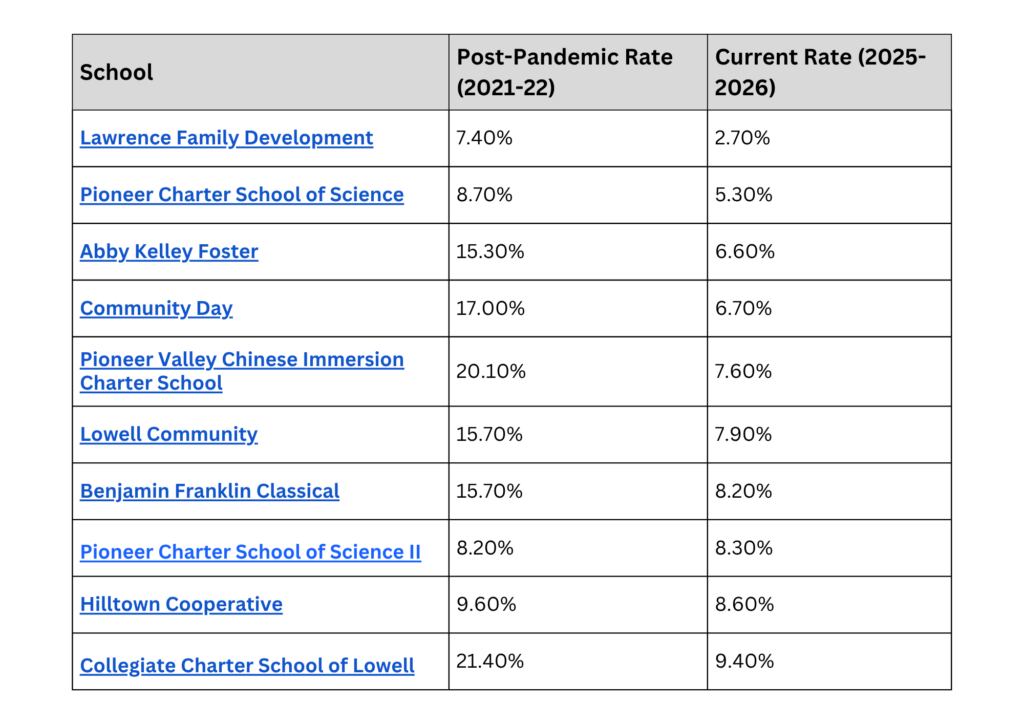
Some charter public schools stand out statewide. Even as they faced post-pandemic increases, they brought chronic absenteeism down quickly and recorded some of the lowest rates in the Commonwealth this past year.
What strategies are charter public schools leveraging to reduce rates of absenteeism?
Charter public schools that have brought down their rates aren’t relying on a single fix. They layer multiple approaches, built on the idea that students attend when they feel seen and known, when families understand why attendance matters, and when schools work to remove the barriers preventing higher engagement.
Know who’s missing, and make the connection.
All schools are starting with their data: who’s missing today? But someone still has to pick up the phone, and sometimes that call can lead straight to a fix.
At Learning First Charter Public School, nearly one in three students was chronically absent in 2021-22. By 2025-26 that rate was down from 31.2% to 12.6%. The school adopted PowerSchool’s Attendance Suite, which automatically flags students as they near set absence thresholds. Learning First also added a Dean of Family and Community Engagement and another guidance position, so that when the data flagged a student, someone had time to call the family and build an individual plan.
Springfield Prep gave that responsibility to specific adults: staff members each carry a caseload of students who need extra attendance support. They work directly with families on practical obstacles like transportation, illness, appointments and travel. Springfield Prep’s rate fell from 24.6% in 2021-22 to 9.6%.
At Collegiate Charter School of Lowell, attendance officer Stephanie Cardoso contacts the family of every absent student each day to find out what happened. Often the answer is simple: the student missed the bus, or a parent’s car broke down. When that happens, the school can send a van to bring the student in. A day that would have been lost becomes a late start instead. Cardoso says families and students have welcomed the approach. The school’s chronic absenteeism rate fell from 21.4% to 9.4%.
At Community Day Charter Public School, each small school community of about 85 to 165 students has its own Operations Manager. Every morning, that manager personally calls the family of every absent student. The call is a chance to learn what’s getting in the way, to connect families with support, and to let them know their child was missed. Community Day’s rate fell from 17.0% to 6.7%.
At Lawrence Family Development Charter School, the relationship starts before the first day of school, with a home visit to every new family that covers expectations like attendance. After that, receptionists call home every day a child is absent. Once a child reaches 5 unexcused or 9 total absences, the school holds a meeting with the family. Lawrence Family Development’s rate was just 2.7% in 2026, the 4th lowest rate in the Commonwealth across district and charter public schools.
KIPP Academy Lynn, now at 10.7%, pairs daily calls home with weekly staff attendance meetings, as well as periodic celebrations of attendance progress. As KIPP Massachusetts Executive Director Nikki Barnes put it, “Students can’t learn if they’re not in school.”
Make school a place students want to be.
Calling home tells families that the school noticed. The schools that saw some of the biggest gains also gave students and families reasons to come in the first place.
Lowell Community Charter Public School fills its calendar with ways for families to come into the building: curriculum nights, a harvest dinner, a June block party, adult English classes, and at least five cultural celebration assemblies each year. In fall 2023, the school launched an “Attendance Matters” campaign, which included letters home at 3, 5 and 7 absences. Students who improve their attendance are recognized at monthly community meetings alongside those with near-perfect records. Lowell Community’s chronic absenteeism rate fell from 15.7% in 2021-22 to 7.9%.
Veritas Preparatory Charter School had a steep starting rate to overcome: 39.4% of students were chronically absent in 2021-22. Veritas paired two messages. The first was clarity: staff talked with students early and often about how absences affect grades and the risk of being held back. The second was belonging: the school made sure students felt supported by teachers, counselors and its school culture team. Students who fell behind got extra academic help, including Saturday school. The rate has since fallen to 14.9%.
Foxborough Regional Charter School, at 10.4%, credits a combination of family partnership, belonging and consistent communication. New Heights Charter School of Brockton, at 15%, points to its early college program, which reinforces the idea that showing up every day matters for a student’s future. Its founder, Omari Walker, says the school’s “ultimate goal is zero absenteeism.”
Researchers are coming to similar conclusions. CASEL’s Joshua Starr argues in The 74 that outreach and incentives aren’t enough without a sense of belonging, and new UChicago Consortium research links stronger student relationships to higher attendance.
Clear the path, and leave the door open.
Sometimes a student isn’t disengaged at all. Something concrete is in the way.
Hampden Charter School of Science, drawing students from a number of surrounding communities, focused on making transportation more accessible and reliable, recognizing its importance for students traveling from surrounding communities. Attendance is treated as a shared responsibility among families, teachers, counselors and administrators to ensure all stakeholders are committed to getting students in the door. Its rate fell from 23.5% in 2021-22 to 17.0%.
Boston Collegiate tackled a different barrier. Working with the Brookline Center for Community Mental Health, it created a BRYT room where students struggling with mental health can get support, especially when they’re returning from time away. Weekly attendance teams track who is missing and why. For high schoolers whose absences have piled up, Saturday school offers a way to make up both missed work and missed days. Boston Collegiate’s rate fell from 27.2% to 13.2%.
The common thread
These schools differ in size, grade levels and community, but their stories share a pattern. They notice absences early. They respond with a person instead of a policy. They give students reasons to want to be there. And they treat a missed day as a shared challenge to address rather than an individual mark on a record. Statewide results for all public schools show that absenteeism remains above pre-pandemic levels. These schools show that progress is possible.
Learn more
- Explore the latest chronic absenteeism data: DESE 2025-2026 Attendance Report
- Read more news about charter public schools in Massachusetts: https://masscharterschools.org/media/
- Does your school have an attendance strategy that is working? Share it with our team at [email protected]